The relationship between Alexander Hamilton and his sister in law Angelica Church has been the subject of debate between historians for a long time. Many would argue that they were engaged in an extramarital affair, but according to myself and many others this is highly unlikely. But that’s actually not what I’m going to talk about today. Instead, I will only present facts, and try to make sense of them in order to give you a picture of what the relationship between Hamilton and Church was actually like.
“I wish to have a conversation with you…. If you will name a day for taking a family dinner with me, I shall think it the best arrangement… The chief subjects will be additional funds for public Debt and the Bank. Would you have any objection that Mr. Fitsimmons should be of the party?”
— Alexander Hamilton to Robert Morris, November 9, 1790
A perfect example of how Hamilton’s political frankness. A similar invitation to discuss politics written by Jefferson would have been way less direct. I will post a quote from him shortly so you can see the difference.
“Alexander Hamilton lasted thirty-one hours after Aaron Burr shot him. When they finally got him into a bed on the second floor of Bayard’s house on Chambers Street, he was nearly comatose. The doctor undressed him and administered a large dose of a strong anodyne, a painkiller. During the first day, Hosack gave Hamilton more than an ounce of an opium and cider potion, called laudanum, washing it down with watered wine. But, Hosack noted, “his sufferings during the whole day were almost intolerable.” The ball had lodged inside his second lumbar disk, which had shattered, paralyzing his legs. His stomach was slowly filling with blood from severed blood vessels in his liver. Hosack “had not the shadow of a hope of his recovery,” but he called in surgeons from French men-of-war anchored in the harbor who “had much experience in gunshot wounds.” They agreed that Hamilton’s condition was hopeless.”
— Willard Randall, Alexander Hamilton: A Life (via publius-esquire)
“You see I give you an account of all the pretty females I meet with; you tell me nothing of the pretty fellows you see. I suppose you will pretend there is none of them engages the least of your attention, but you know I have been told you were something of a coquette, and I shall take care what degree of credit, I give to this pretence. When your sister returns home, I shall try to get her in my interest and make her tell me of all your flirtations.”
—
From Alexander Hamilton to Elizabeth Schuyler, 3 September 1780. [x]
From the same letter, in the ongoing saga of “Alexander Hamilton hates everyone”:
Do not however I entreat you suppose that I entertain an ill opinion of all your sex. I have a much worse of my own. I have seen more of yours that merited esteem and love, but the truth is, My Dear girl, there are very few of either that are not very worthless.
It’s Alexander Hamilton’s birthday today, so I thought I would look into the ways in which Americans celebrated birthdays in the late 18th-century. I found very, very little. So, I dug through everyone’s favorite website, Founders Online, and found any mention of birthdays I could. Royal birthdays were traditionally marked by large balls and other public celebrations, and after the colonies declared independence they began to celebrate George Washington’s birthday this way instead. Since Washington’s birthdays were outliers, I ignored them.
In general, it seems that personal birthdays were widely celebrated. Benjamin Franklin’s wife, Deborah, wrote him in 1765 to say that their friend Mr. Bartram (presumably John Bartram) “asked us to celebrate his Birthday.” Celebrating a birthday in someone’s absence seems to have been relatively common: Eleanor Morris, Mary Hewson, and Sarah Bache all wrote Franklin to let him know that they would be keeping his birthday, in 1768, 1779, and 1783 respectively. Morris says that she and her cousins celebrated his birthday (“that Happy Day”) by having plum pudding with their dinner and drinking tea to his health. Bache, his daughter, claims to keep Franklin’s birthday “in the most festive Manner in my power,” and invited sixty children over for a dance.
Birthdays for children were certainly celebrated. Franklin’s illegitimate grandson, William Temple Franklin, wrote to his cousin to say that he would be visiting a friend to celebrate their son’s first birthday. In 1771, Benjamin Franklin wrote to Deborah to say that he celebrated his grandson’s birthday with friends: “At Dinner, among other nice Things, we had a Floating Island, which they always particularly have on the Birth Days of any of their own Six Children.” A floating island is a French dessert, basically meringue floating on crème anglaise. Apparently, fancy desserts were considered an acceptable way to celebrate a birthday.
I found two instances of personalized poems written in honor of someone’s birthday. In 1767, Benjamin Franklin wrote a poem for Mary Stevenson, the daughter of his London landlady, which included the line “You’d have the Custom broke, you say, That marks with festive Mirth your natal Day,” which also implies that birthday parties were considered customary. On February 21st, 1793, George and Martha Washington sent a birthday greeting to Elizabeth Willing Powel and expressed their regrets that they were unable to attend her 50th birthday party that evening. They also enclosed a personalized birthday poem. In 1814, John Quincy Adams’s seven-year-old son wrote from Saint Petersburg to say that he had performed in a French play at the birthday dinner of a Mr. Krehmer (presumably Sebastian Krehmer, a banker). The dinner ended with a dance.
John Adams, in true New England fashion, marked his 37th birthday by writing this in his journal: “Thirty Seven Years, more than half the Life of Man, are run out.—What an Atom, an Animalcule I am!—The Remainder of my Days I shall rather decline, in Sense, Spirit, and Activity. My Season for acquiring Knowledge is past.” Slightly more optimistically, he writes, “And Yet I have my own and my Childrens Fortunes to make. My boyish Habits, and Airs are not yet worn off.” Two years later, he noted his 39th birthday but wrote nothing else about it and seemed to have spent most of the day traveling.
If we sometimes caricature Ben Franklin as our most bacchanalian founder, and John Adams as a bit of a Puritan stick-in-the-mud, I feel like these examples provide a good range. There are many other examples of letters that simply begin with a birthday greeting, or dates that note that it’s the author’s birthday. Most people seem to have kept track of their birthdays and mentioned them to friends and family, and quite a few seem to have celebrated with dinners, poems, special desserts, and even dances.
So, what about our birthday boy, Alexander Hamilton? Well, he never mentions his birthday in any of his surviving letters. On January 10th, 1772, the day before his 17th or 15th birthday, he wrote to his employer, Nicholas Cruger, to let him know how business was going. At the end, he thanked Cruger “for the Apples you were so kind as to send me,” but there is no other personal information. It seems extremely unlikely that these apples were some sort of birthday gift, since the last letter he’d had from Cruger was from December 20th, 1771. The only notable thing about Hamilton’s birthday seems to be that he didn’t take a break. There are plenty of work-related letters sent on the 10th, 11th, and 12th of January throughout his life. On his 34th or 36th birthday, he wrote a particularly lengthy one to Thomas Jefferson, entirely concerned with politics. So if you were curious about how Hamilton celebrated his birthday…he might not have.
“Who could have imagined, my friend, a man of your size, your delicate constitution, and your peace would have shone as, and in so little time, in the Champ de Mars, you did. I assure you sir that I am greatly tormented about your health, which has always been very dear to me since the beginning of our acquaintance. I do not know how you can support the difficulty and the hardships of a winter campaign in America. Surely your constitution would never have supported such severity without the assistance of something very extraordinary.”
—
Edward Stevens to Alexander Hamilton, 1778
“a man of your size.” lmfao this is the worst thing, stevens is like “damn ham, you’re so fucking fragile and small the only way you could’ve survived the winter campaign is if god literally intervened to save your tiny ass”
There’s this interesting 1798 letter from Alexander Hamilton to James McHenry (then the Secretary of War) where Hamilton is basically begging McHenry pay him for his work as inspector general of the army.
“I have devoted much of my time to the preliminary investigations [of the army]—and I shall devote a much larger proportion, if I am to consider myself as now in service and intitled to the emoluments of the station. For to be frank with you, it is utterly out of my power to apply my time to the public service, without the compensations, scanty enough, which the law annexes to the office.”
Ok, that is pretty frank. He goes on to explain that the position is actually costing him money:
“From the time it was first known that I had reengaged in military life, the uncertainty of my being able to render services for which I might be retained drove away ☞ more than half my professional practice, which I may moderately estimate at four thousand pounds a year.”
Note the little pointing hand. Hamilton actually drew in a pointing hand so that McHenry paid special attention to how fucked his finances are. It probably looked a bit like this, another manicule from a book Hamilton owned:
He then says that he simply won’t be able to perform his duties properly unless he’s paid more, because the work involves a lot of traveling and “the precedent of last war is a full comment on the propriety of an extra allowance to the Inspector General. It is indeed indispensable if he is to be useful.” Hamilton says that he’s faced with the choice of doing an inadequate job or of “ruining myself once more in performing services for which there is no adequate compensation.” I’m not sure what particular thing he’s referring to when he says “ruining myself once more,” but I suppose he could be talking about his tenure as Treasury Secretary.
Finally, he closes with this:
“It is always disagreeable to speak of compensations for one’s self but a man past 40 with a wife and six Children, and a very small property beforehand, is compelled to wave the scruples which his nicety would otherwise dictate.”
Oh my god, this wasn’t even the end of it. So this letter was from November 30th, and McHenry responded in mid-December to be like “oh shit, yeah, you should be getting paid.” Then there’s another letter from Hamilton, dated January 7th, 1799. He begins by saying that “the unascertained situation, in which I have been, since my acceptance of the Military appointment, I now hold, has been not a little embarrassing to me.” So we’re off to a good start.
Apparently he waived pay until called into active service,
“But presuming that I would speedily be officially charged with the execution of duties, which would draw along with them the compensations attached by the law to the station, I have acted on that presumption. I have discontinued my practice as Attorney and Solictor, from which I had derived a considerable part of my professional profits; and I have applied no small portion of my time to preliminary investigations in order to the collection of the best lights for forming a system of Tactics and discipline as perfect as exists any where else.”
Okay, so he’s pissed because he’s basically been devoting himself wholly to the army, and he reminds McHenry again that a lot of his clients were driven away when he first took the position.
“Were I rich I should be proud to be silent on such a subject. I should acquiesce without an observation—as long as any one might think the minutest public interest required an accumulation of sacrifices on my part. But after having to so advanced a period of my life devoted all my prospects of fortune to the service of the Country —and dependant as I am for the maintenance of a wife and six children on my professional exertions, now so seriously abridged—it is essential for me to forego the scruples of delicacy and to ask of you to define my situation; that I may determine whether to continue or to change my present plan.”
He’s really asking McHenry to ask Adams what his employment situation is, since they might not consider his preliminary investigations to be actual military service. He finishes by saying that if it turns out he hasn’t been officially employed this whole time and therefore no one owes him a salary, “my honor will compel submission to the consequent sacrifice, so far as it is unavoidable; but my arrangements will be different from what they are at present and will aim at making the sacrifice as small as possible.” Translation: “My honor forces me to suck it up and keep working, but I’m gonna have to tighten my belt (and maybe do a shittier job as inspector general, sorry I don’t make the rules also fuck you).”
People did think Alexander Hamilton and Ned Stevens looked remarkably alike and that it was awfully nice for Hamilton to be taken in by the Stevens’ family after his cousin died.
If people want to speculate about his paternity based on that, then they can, I guess.
At first I thought Timothy Pickering (Hamilton’s friend) was the first to propose this theory, but John Adams (not Hamilton’s friend) was already throwing around allegations that Edward Stevens was Hamilton’s half-brother as early as 1800, which leads me to believe that theories were probably going around shortly after Stevens came to America. I imagine they have to have heard they were similar looking before, since Stevens’s brother-in-law James Yard said the comment had been made “thousands of times.”
The problem then becomes whether or not either Rachel was in St. Croix or Thomas Stevens in Nevis in 1754/1756, and well I’ve never found any evidence in available tax records that they were together at any point during those years. (I mean it’s possible that one could have visited the island of another without staying long enough to be put on a tax record.)
After Rachel’s death, after the suicide of their cousin and death of their uncle, the Hamilton boys pretty much didn’t have much family left to take them, and the local government wasn’t going to have a couple of unsupervised white boys running around, so it’s likely Thomas Stevens volunteered to take them in – by this point Alexander was already friends with Edward, who had just been sent to America for college by the time of Peter Lytton’s death, so it’s possible Stevens saw it as taking in the friend of his son.
William Cissel does find possible evidence that Thomas Stevens did initially take both Hamilton boys in, not just Alexander, as in 1769 the registers read that the household had two “white male servants” that hadn’t been listed before. By the 1772 register the “white male servants” are gone (Hamilton may have been upgraded), and James, Jr., had gone to live elsewhere.
So that’s pretty much all we know. I mean, it’s possible Stevens could have been the baby daddy, but eh until DNA evidence finally compares Hamilton’s line with the Stevens line we’ll never know.
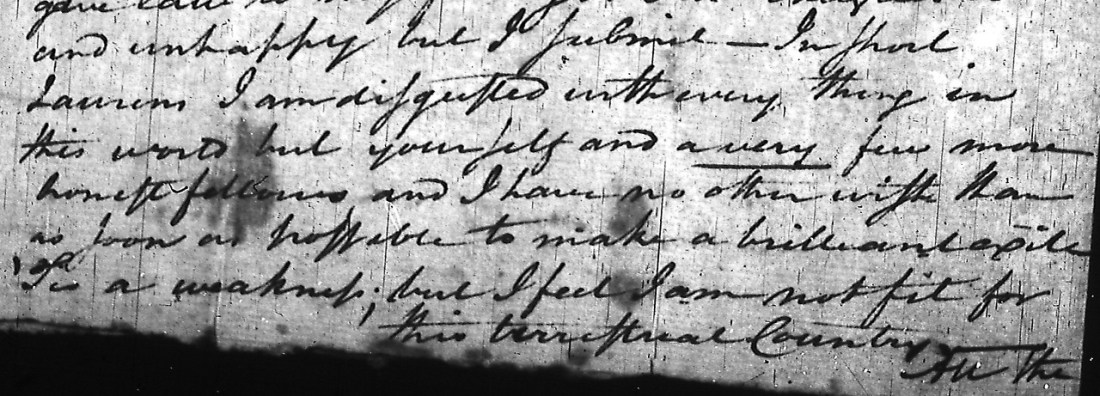
In short Laurens I am disgusted with every thing in this world but yourself and a very few more honest fellows and I have no other wish than as soon as possible to make a brilliant exit_ ‘Tis a weakness; but I feel I am not fit for this terrestreal Country_
– Alexander Hamilton to John Laurens, January 8, 1780
“Lafayette and Hamilton formed a lifelong friendship. That became a triangle at the end of August with the arrival of John Laurens. Twenty-three years old, he also was a slender young man, whose head seemed large for his body. It carried a handsome face with a high brow, noble nose, and strong chin. His wide eyes, as blue as Hamilton’s, were set deep. His full mouth seemed always on the verge of a smile, from either amusement or arrogance, depending on the situation. He was almost as brilliant as Hamilton, but his mind was of a different order. While the one wanted to build a model world as if it was an engineering project, Laurens was on a crusade to improve mankind. He shared Hamilton and Lafayette’s lust for glory on the battlefield. Reckless as they were, neither matched Laurens’ tendency to lunge into the fight without thinking. They survived the war.He did not.”
– David A. Clary, Adopted Son: Washington, Lafayette, and the Friendship that Saved the Revolution

 Daintyfire