That sounds like a title of an “indie” (note, released by a major studio but made by an arthouse director) flick. But no! It’s just my attempt to dissect, analyze and quantify the relationship between fictional superheroes, Dick Grayson and Bruce Wayne. I’m going to be using examples from across continuities, so I can’t assert that it is 100% canon as of Flashpoint. This post will largely seek to trace the publication history of Dick and Bruce’s relationship, and show common trends. I have to do one of these posts every once in a while, you guys. Just bear with me.
I’ve (and my friend, ThoughtsAboutDickGrayson) asserted before that the relationship between Bruce and Dick, as compared to Bruce’s relationship with all the other Robins, is special. Which is not to undercut Bruce’s relationships with Jason, Tim or Damian (although I think we can all agree, Bruce hates Stephanie Brown. He hates her so much she’s not even canon anymore). But Bruce and Dick’s relationship has a complexity and depth to it that Bruce’s relationship to the other Robin’s doesn’t have. And, as has been previously stated, that relationship is both endearing and deeply pathological. This will be one of four posts, dissecting the relationship from Bruce’s perspective, Dick’s perspective, and then what is endearing, and what is pathological, about the relationship.
I’m going to begin, as everything does, with Bruce. Bruce’s psychology is not especially complicated. Lil’ Bruce Wayne is a deeply introverted youngster, with very few social bonds. His parent’s wealth isolates him from his peers, and his intelligence allows him to see through the people who would be his friend because of his money. At a time when most children’s primary social bonds are moving from parents to peers, Bruce is still stuck on his parents. Oh, he has other bonds. To his only friend, Thomas Elliot, the future Hush. And more importantly, to his family’s butler, Alfred, who is part father, part older brother (and eventually, part comrade and co-conspirator, rather eerily echoing Bruce’s eventual relationship with Dick).
It doesn’t help that Bruce, being the child of billionaire parents, has an extremely naive world view. Because what happens all those years ago in Crime Alley destroys Bruce’s primary social bonds, and reduce Bruce to a psychological ground zero.
Now, let’s flash forward. Bruce is now Batman. The sundering of his primary social bonds (as well as his bond to Thomas Elliot) has led Bruce to a very, very dark place. Sure, Alfred’s there, but he’s not happy. Hell, neither is Bruce. Jeph Loeb’s masterworks, The Long Halloween and Dark Victory, do a very good job at highlighting this point. Batman is very alone. He feels it in his mission, and mentions it frequently, but he is alone personally, as well. He has Alfred, and Catwoman is trying to work her way past his emotional barriers, but he is very much alone. And he’s too afraid to let anyone in, because that trauma of losing his parents, his primary social bonds, is still to fresh. In order to be Batman, it *has* to be fresh. And so he keeps those walls high and strong, but the price of that is that Bruce is very lonely. And that misery just makes him angrier, because it reminds him of what he’s lost.
But don’t get me wrong. That doesn’t make Bruce a bad person, or an uncaring one. Bruce actually cares very very deeply for others (See Justice League Unlimited: Epilogue and Infinite Crisis). If he didn’t, his parent’s death wouldn’t be as devastating as it was. He just can’t acknowledge it, because to acknowledge it would make him vulnerable, and he’s too afraid to put himself out there.
Enter Dick Grayson. Bruce is at the circus the night that Dick’s parents are killed, and on that night, that deep compassion for others in Bruce completely overwhelms those walls. Because Bruce has been exactly where Dick is now, and knows how much it hurts.
And then everything changes. Bruce, who still struggles to keep himself from being vulnerable, can’t fully hide that loving part of himself anymore. Because that warm, happy, bubbly, energetic little boy who Bruce has taken under his wing brings it out in him every time. Bruce himself says of Dick, in Batman #682: ““It was as if color had come back into our monochrome lives….Everything changed.” And it changes his relationships with everyone: Alfred, Catwoman, Superman, even the League. He’s happy, because Dick makes him happy. Dick is well known in the DC universe for his warmth, and for the joy he brings to everything he does. And he brings out those feelings in others, because he’s a joy to be around. But that’s especially important for Bruce, who doesn’t just like that about Dick, but needs exactly that in his life.
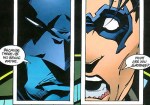
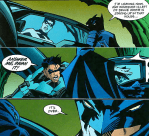
This, I think, is the reason why Dick is consistently referenced as the person Bruce cares most about, the person who will save him from himself (see Infinite Crisis and New 52 Batman #11, I think). Because Dick literally lights up Bruce’s life. Without him (or at least, a Robin to remind him of Dick), Bruce slowly goes back to that place, where he’s alone and sad. This is why Dick’s transition to Nightwing was so difficult. Dick grew up, and needed to become his own person. But that threatened Bruce, who needs Dick. He was scared that Dick becoming his own hero would mean that he would also leave Bruce’s life. Admittedly, part of that is Bruce’s paranoia and fear of loss affecting his judgement. Just because a kid grows up doesn’t mean they stop being a part of their parents’ lives. But Bruce, like any parent, struggles with the concept of letting the bird (puns!) leave the nest.
But thankfully for Bruce, he will always have Dick Grayson. And, as we see in my analysis of the relationship from Dick’s perspective, he always will.
(Read Parts 2, 3, and 4!)























 Daintyfire