Colonel Beckwith tells me that our dear Hamilton writes too much and takes no exercise, and grows too fat. I hate both the word and the thing, and I desire you will take care of his health and his good looks, why I shall find him on my return a dull, heavy fellow! He will be unable to Flirt as Robert Morris; pray, Betsey, make him walk, and ride, and be amused.
Angelica Church to Elizabeth Hamilton, April 25, 1788
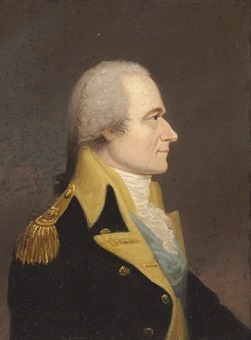
In 1795, Alexander Hamilton, at the age of thirty-eight, resumed the practice of law in the city of New York, and there continued until the close of his life. In December of that year, his personal appearance was this: He was under middle size, thin in person, but remarkably erect and dignified in his deportment. His bust, seen in so many houses, and the pictures and prints of him make known, too generally, the figure of his face to make an attempt at description expedient. His hair was turned back from his forehead, powdered, and collected in a club behind. His complexion was exceedingly fair, varying from this only by the almost feminine rosiness of his cheeks. His might be considered, as to figure and color, an uncommonly handsome face.When at rest, it had a rather severe and thoughtful expression; but when engaged in conversation, it easily assumed an attractive smile. He was expected, one day in December, 1795, at dinner, and was the last who came. When he entered the room, it was apparent from the respectful attention of the company that he was a distinguished individual. He was dressed in a blue coat with bright buttons; the skirts of his coat were unusually long. He wore a white waistcoat, black silk small clothes, while silk stockings.
i am having a significant amount of trouble finding enough information on men’s wigs/hair care in the 18th century. a lot of the same information keeps getting repeated. here’s what i want to know:
did hamilton wear a wig or powder his hair? at the very least it doesn’t look like he’s wearing one in the ezra ames portrait, but that would’ve been when wigs had pretty much gone out of style. i mean, after studying a bunch of portraits i’m under the impression that it’s his natural (fairly curly) hair, but i really don’t know.
if someone powdered their hair, how often did they do so and how often did they remove the powder? i know it was messy and greasy, it seems difficult to sleep in.
if a man wore a wig, did he always shave his real hair?
did men sleep with their hair in a queue? did they use some kind of hair net to keep their pillows clean?
honestly, if you know the answer to any of these questions (or if you just have some thoughts to add) hmu. i swear there’s a reason i’m asking, though it’s not a very good reason.
Hamilton powdered his hair. His son James remembered that his father had basically a daily hairdresser who powdered, pomatumed, combed, platted, and clubbed his hair back in a queue. That kind of hair styling had the potential to take a couple of hours. It was generally believed at this time that the hair powder is what kept the hair clean.
I can’t find info on how often they removed the powder, but to keep their pillows clean when their hair was powdered, they wore night caps,
*cracks knuckles* Finally, my time has come! *uses interest in 18th Century fashion and grooming for good and not for evil*
A typical hair care and styling regimen for women, and fashionable men who did not wear wigs, in the 18th century was:
1. Take down your hairdo at the end of the day, massage a small amount of pomatum, a mixture of mutton fat, lard, and aromatic oils such as clove and lemon, into the hair and scalp, add powder, and brush vigorously for quite some time. The effect is similar to contemporary dry shampoos. Although very rarely, if ever, washed with water and soap, this routine effectively cleans the hair and scalp without stripping natural oils and leaving it full of texture and body and enough oils to make styling easier– squeaky clean, freshly shampooed hair is notoriously hard to style, especially in elaborate updos and curls. Men and women alike wore nightcaps to protect their bedding from any powder or pomatum that might be left and probably also to help prevent long hair from getting too messed up. Unlike women, men might not undo their hair every night, and would wear hairnets to help preserve their style overnight.
2. In the morning, more powder was added before brushing. Powder was made of finely ground starch, bones, and clay, along with aromatic powders such as orris root. Women who wished to achieve towering ‘dos rolled sections of their hair over fluffy pads and added curls with curling irons. Men usually did not have the towering hairdos, but definitely would have added curls with a curling iron, if they had the luxury of a hairdresser (I read that Hamilton had a hairdresser come to his house every day, so he may have added curls sometimes). If a lighter white color was desired, the hairdresser would apply more powder to the finished style with a large puff while their client covered their face with a cone-shaped piece of paper so it didn’t also get powdered.
3. Wigs. Contrary to popular belief, women achieved many of their towering hairstyles without wigs. Most women wore their own, natural hair with, perhaps, extensions to bulk it out a bit if necessary. However, most of the popular, everyday styles could be achieved simply with waist-length hair, pads, and curls. Men, on the other hand, routinely wore wigs. Covering baldness was a big part of wigs’ popularity among men, but also, the time involved in styling hair may have interfered with men who had business, politics, and other important matters to attend to. Wigs could be sent off to a professional for regular maintenance and simply plopped on the head in the morning, like a hat. Men who wore wigs usually kept their natural hair cut very short, or even shaved, as in this picture from Hogarth’s “A Rake’s Progress”, where the main character has let his wig fall to the floor:
And this handsome gentleman, lounging at home in informal leisure wear– a banyan and nightcap:
Because wigs were expensive, they marked social class, with the most elaborate styles that required the most upkeep for the wealthy and the fops, and simpler styles that varied according to occupation and income.
By the late 1700s, however, wigs were already on their way out. Men of all social classes preferred styles that were fairly simple, and by the 1780s, natural, lightly powdered hair was preferred. In most of the portraits of the Founding Fathers and others who fought in the American Revolution, for example, you see that they are wearing their natural hair, not wigs.
Hamilton, ca. 1780– this is his own hair (I’m assuming, because the hairline is consistent with other portraits and he was probably too poor to even own a wig at this point), but it has been styled to look very much like the popular wig styles of the 1770s-early 80s: brushed back from the forehead, rolled over a pad or simply bulked up with enough pomatum and powder to make a nice roll near the ears, and tied in either a queue or bag in the back:
Which is, incidentally, how George Washington wore his hair, and since Hamilton was his Aide de Camp at the time this portrait was painted, it’s not surprising he wears the same style as his commander.
By 1800, he was wearing his hair like this:
It looks to me like the sides have been curled or rolled vertically to frame his face, while the back is combed flat and tied in a low queue.
This is another view of the same general style. You see the lightly powdered hair brushed up and fluffed a bit with the help of pomatum and powder for volume and hold over his head and around his face. You can see that by the late 1700s-early 1800s, men’s hair was fairly natural-looking, and required a minimal amount of styling and maintenance.
In England, in the 1790s only older men and women being presented at court wore wigs, and in 1795, the British government levied a tax on hair powder that basically ended powdered hair and fashions that relied upon it. However, powdered hair was already mostly over in the US, France and with political progressives in England because of the revolutions: elaborate, powdered hairstyles were associated with aristocracy.
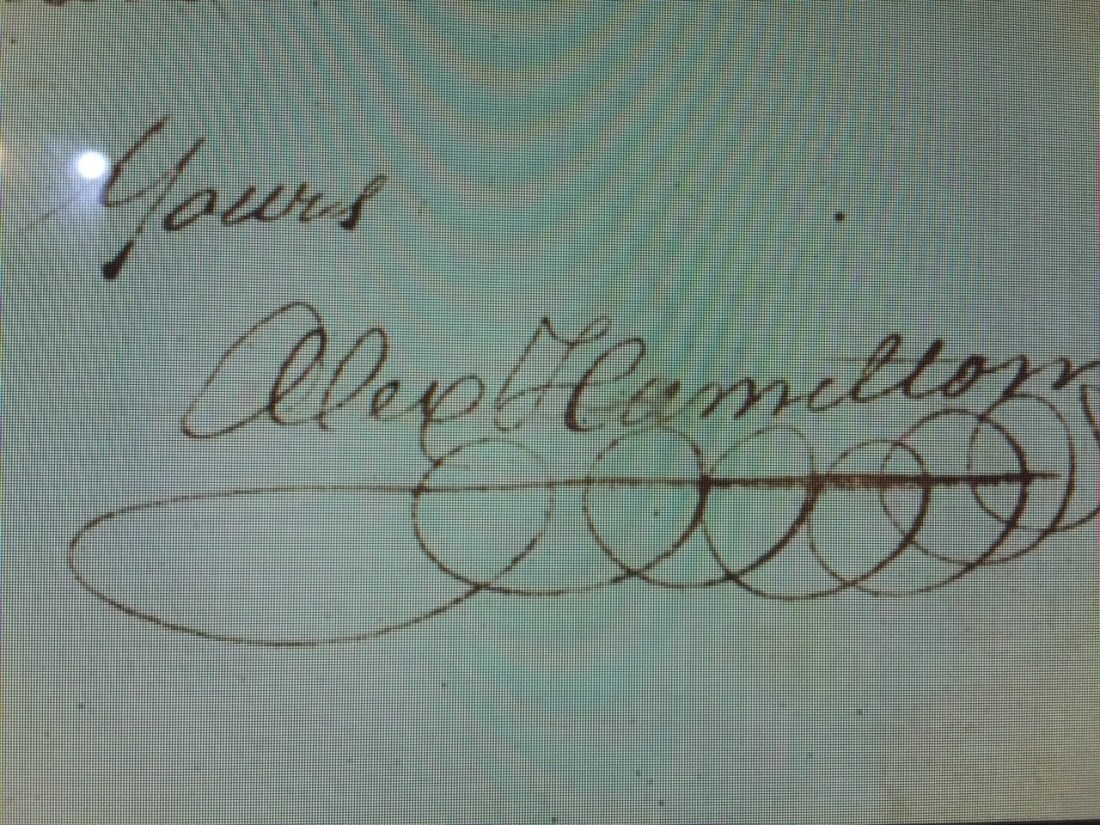
Hamilton’s signature at 14 is no different than me dotting my “i”’s with hearts ♥️ and doing title pages in bubble letters with rainbow colour schemes.
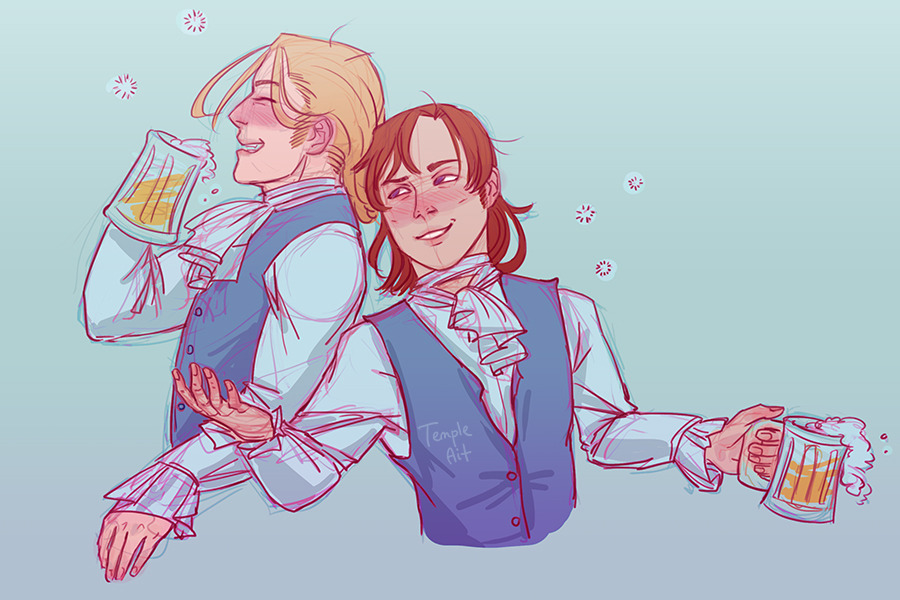
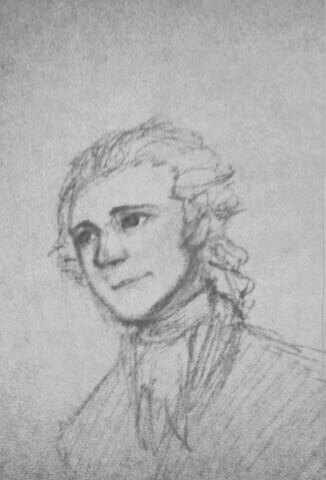
It’s been discussed a lot how Hamilton was often described as feminine by his contemporaries in the standards of their time. I have zero doubts about his dandyism and I’m sure he had delicate mannerisms that, coupled with his pretty-boy looks, gave him that reputation. But, I’ve also been wondering how much of his obsession with war as a youth, his aggression in battle, his preoccupation with having a command, and his actual leadership style were possibly his way of compensating for those mannerisms or at least allowing himself some freedom of expression he wouldn’t have had otherwise.
I mean, we have that famous “I wish there was a war” letter to Ned- which arguably is just a reflection of his desire to have a means of social elevation, but I would argue is coupled with some romanticism about being a war hero. We also know that Hamilton was a fan of Alexander Pope and likely read his translation of the Iliad and was deeply influenced by that story of ancient heroes and violent battles and by the hero Achilles who had a deep relationship with another man (which he also could’ve been exposed to by the sodomite population in the West Indies). He grew up in a place where violence was commonplace between international skirmishes between the British and French and racial violence against a large slave population, so he was definitely exposed to violence as an expression of masculinity- even in men that broke British society’s conventions of sexuality. Then, with his ideals about refinement and gentility and his desire to raise his position in society, he focused his thoughts about violence, glory, and warfare, and formed those into a productive way of establishing himself in society- get a command. And, throughout his career in the military, he gained a reputation for being eager on the battlefield and strict as a leader of troops. While at Valley Forge, he recommended lashings as punishment to Washington as a means of restoring order and he abided by capital punishment. He probably used such means or threats of such means to maintain discipline in his own units. So, you get someone who wants to be involved in warfare and achieve glory through violence as a way of forming his own image as a man.
Couple that image with the preexisting one of a slender man with delicate health and feminine mannerisms, and the masculine image forged in violence and warfare becomes liberating to the intrinsic feminine one.
A lot of men probably used warfare as a way of proving their masculinity- just as men use violence in the same way today. And, think about it- if you had a deep-seated need to be respected in a society extremely hostile to the agency of women, but were frequently described as feminine, you’d look for a way to perform masculinity. If you’d seen that violence and glory were means of doing that, it would make sense to seek battle. And, if femininity was more comfortable for you and you needed to be free to act feminine in some way to be comfortable with yourself, wouldn’t battlefield glory feel like a way of putting a check in the box for everyone else, so you could be free to wear pretty clothes and tell them- ‘fuck off, I won the battle at Yorktown’?
Basically, Hamilton’s intrinsic femininity and his aggression, pride, and violence are all tied together and very interesting.
At forty-nine, he was a year older than Burr and, like him, was a relatively short man–an inch taller, at five feet seven inches–with similarly small hands and feet, a somewhat delicate bone structure, and a truly distinctive head and face. He was called “the little lion of Federalism” because he was, in truth, little.
Joseph J. Ellis, Founding Brothers: The Revolutionary Generation (via yourobedservant)



 Daintyfire