The relationship between Alexander Hamilton and his sister in law Angelica Church has been the subject of debate between historians for a long time. Many would argue that they were engaged in an extramarital affair, but according to myself and many others this is highly unlikely. But that’s actually not what I’m going to talk about today. Instead, I will only present facts, and try to make sense of them in order to give you a picture of what the relationship between Hamilton and Church was actually like.
Tag: history
“I wish to have a conversation with you…. If you will name a day for taking a family dinner with me, I shall think it the best arrangement… The chief subjects will be additional funds for public Debt and the Bank. Would you have any objection that Mr. Fitsimmons should be of the party?”
— Alexander Hamilton to Robert Morris, November 9, 1790
- A perfect example of how Hamilton’s political frankness. A similar invitation to discuss politics written by Jefferson would have been way less direct. I will post a quote from him shortly so you can see the difference.
“Alexander Hamilton lasted thirty-one hours after Aaron Burr shot him. When they finally got him into a bed on the second floor of Bayard’s house on Chambers Street, he was nearly comatose. The doctor undressed him and administered a large dose of a strong anodyne, a painkiller. During the first day, Hosack gave Hamilton more than an ounce of an opium and cider potion, called laudanum, washing it down with watered wine. But, Hosack noted, “his sufferings during the whole day were almost intolerable.” The ball had lodged inside his second lumbar disk, which had shattered, paralyzing his legs. His stomach was slowly filling with blood from severed blood vessels in his liver. Hosack “had not the shadow of a hope of his recovery,” but he called in surgeons from French men-of-war anchored in the harbor who “had much experience in gunshot wounds.” They agreed that Hamilton’s condition was hopeless.”
— Willard Randall, Alexander Hamilton: A Life (via publius-esquire)
“You see I give you an account of all the pretty females I meet with; you tell me nothing of the pretty fellows you see. I suppose you will pretend there is none of them engages the least of your attention, but you know I have been told you were something of a coquette, and I shall take care what degree of credit, I give to this pretence. When your sister returns home, I shall try to get her in my interest and make her tell me of all your flirtations.”
—
From Alexander Hamilton to Elizabeth Schuyler, 3 September 1780. [x]
From the same letter, in the ongoing saga of “Alexander Hamilton hates everyone”:
Do not however I entreat you suppose that I entertain an ill opinion of all your sex. I have a much worse of my own. I have seen more of yours that merited esteem and love, but the truth is, My Dear girl, there are very few of either that are not very worthless.
(via gwenfrankenstien)
Colonial American Birthdays!
It’s Alexander Hamilton’s birthday today, so I thought I would look into the ways in which Americans celebrated birthdays in the late 18th-century. I found very, very little. So, I dug through everyone’s favorite website, Founders Online, and found any mention of birthdays I could. Royal birthdays were traditionally marked by large balls and other public celebrations, and after the colonies declared independence they began to celebrate George Washington’s birthday this way instead. Since Washington’s birthdays were outliers, I ignored them.
In general, it seems that personal birthdays were widely celebrated. Benjamin Franklin’s wife, Deborah, wrote him in 1765 to say that their friend Mr. Bartram (presumably John Bartram) “asked us to celebrate his Birthday.” Celebrating a birthday in someone’s absence seems to have been relatively common: Eleanor Morris, Mary Hewson, and Sarah Bache all wrote Franklin to let him know that they would be keeping his birthday, in 1768, 1779, and 1783 respectively. Morris says that she and her cousins celebrated his birthday (“that Happy Day”) by having plum pudding with their dinner and drinking tea to his health. Bache, his daughter, claims to keep Franklin’s birthday “in the most festive Manner in my power,” and invited sixty children over for a dance.
Birthdays for children were certainly celebrated. Franklin’s illegitimate grandson, William Temple Franklin, wrote to his cousin to say that he would be visiting a friend to celebrate their son’s first birthday. In 1771, Benjamin Franklin wrote to Deborah to say that he celebrated his grandson’s birthday with friends: “At Dinner, among other nice Things, we had a Floating Island, which they always particularly have on the Birth Days of any of their own Six Children.” A floating island is a French dessert, basically meringue floating on crème anglaise. Apparently, fancy desserts were considered an acceptable way to celebrate a birthday.
I found two instances of personalized poems written in honor of someone’s birthday. In 1767, Benjamin Franklin wrote a poem for Mary Stevenson, the daughter of his London landlady, which included the line “You’d have the Custom broke, you say, That marks with festive Mirth your natal Day,” which also implies that birthday parties were considered customary. On February 21st, 1793, George and Martha Washington sent a birthday greeting to Elizabeth Willing Powel and expressed their regrets that they were unable to attend her 50th birthday party that evening. They also enclosed a personalized birthday poem. In 1814, John Quincy Adams’s seven-year-old son wrote from Saint Petersburg to say that he had performed in a French play at the birthday dinner of a Mr. Krehmer (presumably Sebastian Krehmer, a banker). The dinner ended with a dance.
John Adams, in true New England fashion, marked his 37th birthday by writing this in his journal: “Thirty Seven Years, more than half the Life of Man, are run out.—What an Atom, an Animalcule I am!—The Remainder of my Days I shall rather decline, in Sense, Spirit, and Activity. My Season for acquiring Knowledge is past.” Slightly more optimistically, he writes, “And Yet I have my own and my Childrens Fortunes to make. My boyish Habits, and Airs are not yet worn off.” Two years later, he noted his 39th birthday but wrote nothing else about it and seemed to have spent most of the day traveling.
If we sometimes caricature Ben Franklin as our most bacchanalian founder, and John Adams as a bit of a Puritan stick-in-the-mud, I feel like these examples provide a good range. There are many other examples of letters that simply begin with a birthday greeting, or dates that note that it’s the author’s birthday. Most people seem to have kept track of their birthdays and mentioned them to friends and family, and quite a few seem to have celebrated with dinners, poems, special desserts, and even dances.
So, what about our birthday boy, Alexander Hamilton? Well, he never mentions his birthday in any of his surviving letters. On January 10th, 1772, the day before his 17th or 15th birthday, he wrote to his employer, Nicholas Cruger, to let him know how business was going. At the end, he thanked Cruger “for the Apples you were so kind as to send me,” but there is no other personal information. It seems extremely unlikely that these apples were some sort of birthday gift, since the last letter he’d had from Cruger was from December 20th, 1771. The only notable thing about Hamilton’s birthday seems to be that he didn’t take a break. There are plenty of work-related letters sent on the 10th, 11th, and 12th of January throughout his life. On his 34th or 36th birthday, he wrote a particularly lengthy one to Thomas Jefferson, entirely concerned with politics. So if you were curious about how Hamilton celebrated his birthday…he might not have.
Happy 259th/261st birthday, Hammy!
“Who could have imagined, my friend, a man of your size, your delicate constitution, and your peace would have shone as, and in so little time, in the Champ de Mars, you did. I assure you sir that I am greatly tormented about your health, which has always been very dear to me since the beginning of our acquaintance. I do not know how you can support the difficulty and the hardships of a winter campaign in America. Surely your constitution would never have supported such severity without the assistance of something very extraordinary.”
—
Edward Stevens to Alexander Hamilton, 1778
“a man of your size.” lmfao this is the worst thing, stevens is like “damn ham, you’re so fucking fragile and small the only way you could’ve survived the winter campaign is if god literally intervened to save your tiny ass”
When Lafayette visited John adams later in his life, they both commented on how both had changed dramatically since they had last met. Something like “That was not the mani knew”, I’m paraphrasing mind you, but what could have been the change? Were there significant changes in Lafayette’s views at this time?
After the war, during the initial trade negotiations with the newly established United States, Lafayette often strove to interject his own opinions on the matter and wrote to Vergennes and others about what might be beneficial for both countries. Because John Adams needed to be seen as a legitimate ambassador from the United States at the time, Lafayette’s interceding wasn’t welcomed by the future president…and honestly, he wasn’t wrong about that. It’s completely understandable. Lafayette had a tendency to overdue everything put in front of him. At one point, Adams–fed up with the interference–wrote this about the Marquis, convinced that Laf only acted in order to beef up his own sense of personal glory:
‘…this Mongrel Character of French Patriot and American Patriot cannot exist long.’
Over time, John Adams began to suspect Lafayette’s character on the whole, convinced that the Frenchman’s constant involvement was a sign of future problems to come. Their relationship continued on a downward spiral after the establishment of the Society of the Cincinnati, a hereditary society for those who fought in the American Revolution. Adams, who was adamantly opposed to the idea, did not approve of Lafayette’s enthusiastic participation in the Society. John gradually grew to dislike the Marquis on the whole–and he began making it clear.
‘as to your going to America, Surely I have no Objection against it…but I questioned whether you would go, as the War was over, and I knew of no particular Motive you might have to go.’ – March 28, 1784
Lafayette, who had no intention of being an enemy of American progress, didn’t understand the low-key hostility he was receiving.
‘A friendly letter I wrote You, and the One I Receive is not so affectionate as usual….As to My Going to America, I first Went for the Revolution….Now I am Going for the people, and My Motives are, that I love them, and they love me–that My Arrival will please them, and that I will Be Pleased with the sight of those whom I Have Early joined in our Noble and successfull cause….How could I Refrain from Visiting a Nation whose I am an Adoptive Son…?’
Judging by the incorrect English phraseology, the adamant tone, and the copious overuse of capital letters, Lafayette was upset. Adams didn’t reply.
‘Altho’ I have not Been Honoured with an answer to My last letter, I will not loose time in Acquainting you that My departure from l’Orient is fixed on the 22d instant.’
Lafayette offered to deliver any correspondence that John might have. Adams, once again, pulled a Mean Girls.
‘…as there was nothing in it [Lafayette’s prior letter] which required an immediate Answer, I have not acknowledged the Recipt of it, untill now. I will answer the Letters of my Friends by Mr. Reed and Coll. Herman.’
Reed and Herman were mentioned pointedly; they were Americans…and Lafayette was not. Lafayette wrote one more time and, as Laura Auricchio (author of The Marquis: Lafayette Reconsidered) put it, ‘As far as we know, it went unanswered.’ So, when Adams and Lafayette met during Lafayette’s tour of America later in his life, this was the last real correspondence that had gone on between them. Adams, who was in his late 80′s, must’ve looked withered to Lafayette, who was in his 60′s and had known a much more fiery Adams than the elderly man he met.
“John Adams showed how truly thickheaded he could be when he wrote from Paris to his wife running his business and raising his children back in Braintree, Massachusetts. ‘I admire the ladies here,’ he oh so sensitively said, ‘Don’t be jealous. They are handsome and very well educated. Their accomplishments are exceedingly brilliant.’ Abigail had a ready reply: ‘I regret the trifling narrow contracted education of females in my own country…. You need not be told how much female education is neglected, nor how fashionable it has been to ridicule female learning.’ I suspect he needed not be told because she had told him again and again.”
—
the death of john adams june 30 1778
(Founding Mothers by Cokie Roberts)
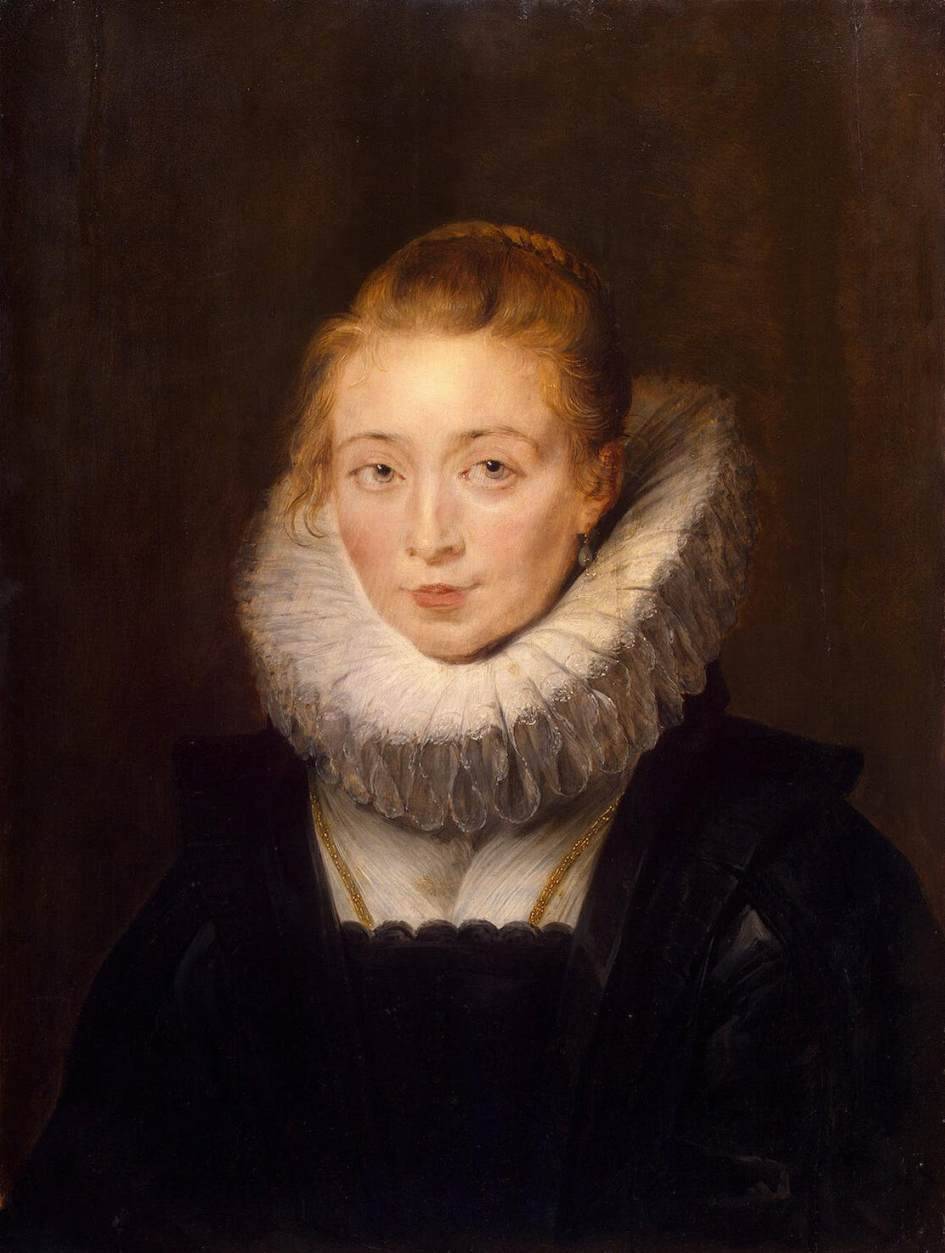
Portrait of a Chambermaid, 1625, Peter Paul Rubens
Size: 48×64 cm
Medium: oil, panel
 Daintyfire