I was looking at this post again, and I was like, “That man has the Hapsburg jaw. I just know it.”
So I looked him up and
I’ll be damned if I didn’t recognize the most prominent birth defect from the incestuous Habsburg family.
The sad thing is he *is* almost kind of normal looking compared to his relatives. And think about it, a Royal Portrait supposed to make you look as good as possible, so they probably looked even worse in reality. Yeah… the moral here is don’t fuck your cousins and siblings, kids.
There’s this interesting 1798 letter from Alexander Hamilton to James McHenry (then the Secretary of War) where Hamilton is basically begging McHenry pay him for his work as inspector general of the army.
“I have devoted much of my time to the preliminary investigations [of the army]—and I shall devote a much larger proportion, if I am to consider myself as now in service and intitled to the emoluments of the station. For to be frank with you, it is utterly out of my power to apply my time to the public service, without the compensations, scanty enough, which the law annexes to the office.”
Ok, that is pretty frank. He goes on to explain that the position is actually costing him money:
“From the time it was first known that I had reengaged in military life, the uncertainty of my being able to render services for which I might be retained drove away ☞ more than half my professional practice, which I may moderately estimate at four thousand pounds a year.”
Note the little pointing hand. Hamilton actually drew in a pointing hand so that McHenry paid special attention to how fucked his finances are. It probably looked a bit like this, another manicule from a book Hamilton owned:
He then says that he simply won’t be able to perform his duties properly unless he’s paid more, because the work involves a lot of traveling and “the precedent of last war is a full comment on the propriety of an extra allowance to the Inspector General. It is indeed indispensable if he is to be useful.” Hamilton says that he’s faced with the choice of doing an inadequate job or of “ruining myself once more in performing services for which there is no adequate compensation.” I’m not sure what particular thing he’s referring to when he says “ruining myself once more,” but I suppose he could be talking about his tenure as Treasury Secretary.
Finally, he closes with this:
“It is always disagreeable to speak of compensations for one’s self but a man past 40 with a wife and six Children, and a very small property beforehand, is compelled to wave the scruples which his nicety would otherwise dictate.”
Oh my god, this wasn’t even the end of it. So this letter was from November 30th, and McHenry responded in mid-December to be like “oh shit, yeah, you should be getting paid.” Then there’s another letter from Hamilton, dated January 7th, 1799. He begins by saying that “the unascertained situation, in which I have been, since my acceptance of the Military appointment, I now hold, has been not a little embarrassing to me.” So we’re off to a good start.
Apparently he waived pay until called into active service,
“But presuming that I would speedily be officially charged with the execution of duties, which would draw along with them the compensations attached by the law to the station, I have acted on that presumption. I have discontinued my practice as Attorney and Solictor, from which I had derived a considerable part of my professional profits; and I have applied no small portion of my time to preliminary investigations in order to the collection of the best lights for forming a system of Tactics and discipline as perfect as exists any where else.”
Okay, so he’s pissed because he’s basically been devoting himself wholly to the army, and he reminds McHenry again that a lot of his clients were driven away when he first took the position.
“Were I rich I should be proud to be silent on such a subject. I should acquiesce without an observation—as long as any one might think the minutest public interest required an accumulation of sacrifices on my part. But after having to so advanced a period of my life devoted all my prospects of fortune to the service of the Country —and dependant as I am for the maintenance of a wife and six children on my professional exertions, now so seriously abridged—it is essential for me to forego the scruples of delicacy and to ask of you to define my situation; that I may determine whether to continue or to change my present plan.”
He’s really asking McHenry to ask Adams what his employment situation is, since they might not consider his preliminary investigations to be actual military service. He finishes by saying that if it turns out he hasn’t been officially employed this whole time and therefore no one owes him a salary, “my honor will compel submission to the consequent sacrifice, so far as it is unavoidable; but my arrangements will be different from what they are at present and will aim at making the sacrifice as small as possible.” Translation: “My honor forces me to suck it up and keep working, but I’m gonna have to tighten my belt (and maybe do a shittier job as inspector general, sorry I don’t make the rules also fuck you).”
People did think Alexander Hamilton and Ned Stevens looked remarkably alike and that it was awfully nice for Hamilton to be taken in by the Stevens’ family after his cousin died.
If people want to speculate about his paternity based on that, then they can, I guess.
At first I thought Timothy Pickering (Hamilton’s friend) was the first to propose this theory, but John Adams (not Hamilton’s friend) was already throwing around allegations that Edward Stevens was Hamilton’s half-brother as early as 1800, which leads me to believe that theories were probably going around shortly after Stevens came to America. I imagine they have to have heard they were similar looking before, since Stevens’s brother-in-law James Yard said the comment had been made “thousands of times.”
The problem then becomes whether or not either Rachel was in St. Croix or Thomas Stevens in Nevis in 1754/1756, and well I’ve never found any evidence in available tax records that they were together at any point during those years. (I mean it’s possible that one could have visited the island of another without staying long enough to be put on a tax record.)
After Rachel’s death, after the suicide of their cousin and death of their uncle, the Hamilton boys pretty much didn’t have much family left to take them, and the local government wasn’t going to have a couple of unsupervised white boys running around, so it’s likely Thomas Stevens volunteered to take them in – by this point Alexander was already friends with Edward, who had just been sent to America for college by the time of Peter Lytton’s death, so it’s possible Stevens saw it as taking in the friend of his son.
William Cissel does find possible evidence that Thomas Stevens did initially take both Hamilton boys in, not just Alexander, as in 1769 the registers read that the household had two “white male servants” that hadn’t been listed before. By the 1772 register the “white male servants” are gone (Hamilton may have been upgraded), and James, Jr., had gone to live elsewhere.
So that’s pretty much all we know. I mean, it’s possible Stevens could have been the baby daddy, but eh until DNA evidence finally compares Hamilton’s line with the Stevens line we’ll never know.
“John and Abigail continued to worry over their son’s [Charles’s] alcoholism, and they were outraged when he squandered some of John Quincy’s money that had been entrusted to his care. But something else concerned them as well, although their correspondence and that of Charles’s siblings contains only dark hints and allusions with regard to this other, unspecified behavior. There are references to his alleged proclivity for consorting with men whom his parents regarded as unsavory. John Quincy, who remained a close, tolerant older brother through thick and thin, urged Charles to “be more cautious” and prayed that his conduct would remain within “the limits of regularity.” By the early 1790s, such references may have been occasioned by the fact that Charles was living in New York with an old revolutionary war general, Baron Friedrich von Steuben, who is now thought by some to have been homosexual. Charles clearly adored Steuben – “My dear Mamma there is something in this man that is more than mortal,” he told Abigail – and he was grief stricken when the old man retired to a farm in upstate New York. Following Steuben’s departure, Charles announced his intention of marrying Sally Smith, the sister of his brother-in-law Colonel Smith. Whereas his parents often interceded in John Quincy’s and Thomas’s matrimonial concerns, the vice-president and Abigail seemed almost relived at their son’s decision. Even Nabby breathed a sigh of relief. After “all the Hair breadth scares and iminent dangers he has run, he is at last Safe Landed,” he exalted.”
Charles also had a long history of extreme emotional fragility and a strange and persistent childishness. He was very wont to court multiple girls at once, none seriously, and, as his money issues show, tended to befriend people who then manipulated and preyed upon him.
Each of the four surviving children of John and Abigail Adams suffered a great deal of hardship and personal tragedy during their lives. In childhood, they were all frequently separated from their father–and eventually from their mother as well–due to his involvement in the American Revolution. But their struggles had only begun.
The firstborn–Abigail, called “Nabby”–married a financial failure who had difficulty supporting her and their four children. In 1810, she was diagnosed with breast cancer and underwent a painful mastectomy, but after two years of remission, she eventually returned to her parents’ home in Massachusetts and died in her father’s arms. John Quincy, the eldest Adams son, had a successful career in diplomacy and politics that mirrored his father’s and culminated in his election as the sixth President of the United States. However, he suffered a bitter political defeat after losing his reelection campaign to Andrew Jackson. He may also have struggled with depression, and two of his own three sons were troubled and died in young adulthood. (He and his wife Louisa lost a daughter in infancy as well.) Charles was a charming child and a favorite of both his parents. Like his brothers, he attended Harvard, married, and began a promising legal career in New York–but behind closed doors, he struggled with a severe alcohol problem. His habits were so disgraceful that his father disowned him, calling him a “Beast,” before he died of cirrhosis of the liver at just thirty years old. The youngest Adams child, Thomas, also began his adult life with promise. He and his wife had seven children, but unfortunately he shared Charles’ alcoholism (the disease ran in Abigail’s family). His decline was much slower, but he was frequently ill and had amassed large debts by the time he died in 1832.
John and Abigail also had a fifth living child, Susanna, but she was sickly and lived for only fourteen months. Abigail’s last pregnancy ended in the stillbirth of what would have been her third daughter. They called the baby Elizabeth.
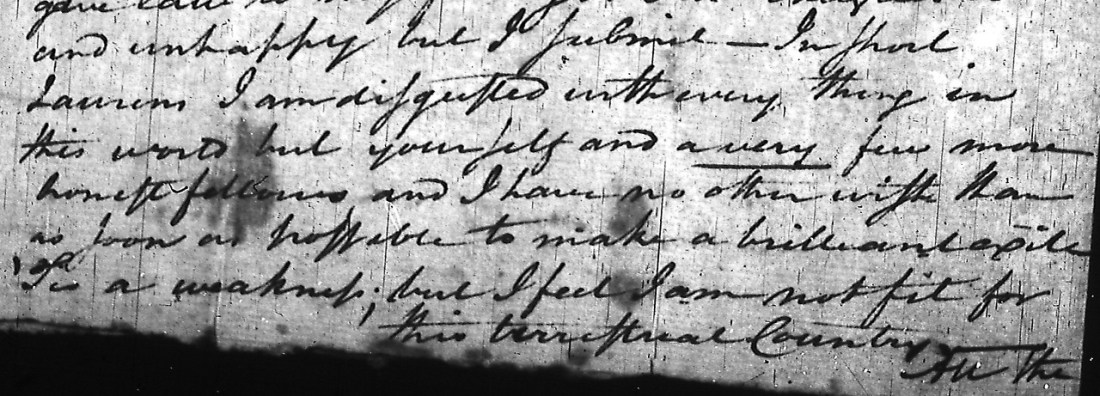
In short Laurens I am disgusted with every thing in this world but yourself and a very few more honest fellows and I have no other wish than as soon as possible to make a brilliant exit_ ‘Tis a weakness; but I feel I am not fit for this terrestreal Country_
– Alexander Hamilton to John Laurens, January 8, 1780
“Lafayette and Hamilton formed a lifelong friendship. That became a triangle at the end of August with the arrival of John Laurens. Twenty-three years old, he also was a slender young man, whose head seemed large for his body. It carried a handsome face with a high brow, noble nose, and strong chin. His wide eyes, as blue as Hamilton’s, were set deep. His full mouth seemed always on the verge of a smile, from either amusement or arrogance, depending on the situation. He was almost as brilliant as Hamilton, but his mind was of a different order. While the one wanted to build a model world as if it was an engineering project, Laurens was on a crusade to improve mankind. He shared Hamilton and Lafayette’s lust for glory on the battlefield. Reckless as they were, neither matched Laurens’ tendency to lunge into the fight without thinking. They survived the war.He did not.”
– David A. Clary, Adopted Son: Washington, Lafayette, and the Friendship that Saved the Revolution
Yes, Peggy Arnold did have that breakdown at West Point after her husband defected. However, it was COMPLETELY staged! She was left behind at West Point with her son Edward who was still a baby. George Washington had breakfast with her that morning. Lafayette reproached Washington playfully, saying how the young men (mostly aides) waited their breakfast with “ravishing” Peggy Arnold. Washington said in return:
“Ah, I know you young men are all in love with Mrs. Arnold … You may god and take your breakfast with her and tell her not to wait for me.”
Two aides, Samuel Shaw and James McHenry went ahead and told Peggy that a large party of guests had been delayed but would shortly arrive for breakfast. When Washington dismounted at the Robinson House where the Arnolds were stayed, one of Arnold’s aides, Major David Franks explained that Arnold had been summoned to West Point on an urgent call and that Peggy Arnold lay abed upstairs. Late into the afternoon there was still no sign from either Peggy or her husband. Arnold had long hopped on a barge that André was supposed to be on and Peggy staged her scene.
It was Lieutenant Colonel Richard Varick who initially notified Washington of the “delirious” behavior of Peggy Arnold upstairs. he had found her roaming the halls in a state of partial undress and coaxed her back to bed where she insisted that “there was a hot iron on her head and no one but General Washington could take it off.” When Washington went upstairs to calm her, he found her hugging her child, Edward, to her breast. She pretended not to recognize Washington. “There is General Washington,” Varick urged her gently.
In return Peggy insisted, “No that is not General Washington! That is the man who is a-going to assist Colonel Varick in killing my child.” She added, “General Arnold with never return. he is gone forever, there, there, there.” She motioned toward the ceiling saying, “The spirits have carried him up there. They had put hot irons in his head.” She fooled everyone and played it to perfection. Hamilton wrote to his wife, Elizabeth Hamilton:
“It was the most affecting scene I ever was witness to. [For a considerable time, Peggy had] entirely lost her senses … One moment she raved, another she melted into tears. Sometimes she pressed her infant to her bosom and lamented its fate, occasioned by the imprudence of its father, in a manner that would have pierced insensibility itself.:
After the event, believed to be innocent, Peggy was sent back to Philadelphia where her family resided. Theodosia Prevost had been a good friend of hers and Peggy had stayed with Prevost in what is now Paramus, New Jersey, enroute to Philadelphia from West Point. Peggy, unable to take the lying anymore, confessed everything to Theodosia, telling her that “through unceasing perseverance, [Peggy] had ultimately brought the general into an arrangement to surrender West Point.” Nobody saw that the reaction was a farce.














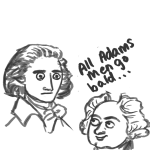
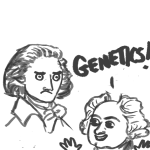
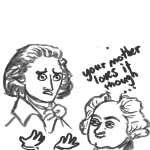

 Daintyfire