Martha [Washington] in particular found [von Steuben’s] accent and his occasional difficulties with the English language highly amusing. The Baron knew when he had an appreciative audience, so he pretended to be clumsier with the language than he actually was. One evening Martha asked him how he passed the time now that his military duties were somewhat reduced. Steuben replied that he read, wrote, played chess, and–for the first time in his life–went fishing. But he knew he wasn’t a very good angler, he confessed, for he had sat in a boat in the Hudson for three hours and had caught only two fish. One of them, he said, was a whale. “A whale, Baron, in the North River?” Lady Washington asked. “Yes, I assure you, a very fine whale.” turning to his staff, he demanded with a wink, “It was a whale, was it not?” Billy North corrected him: “An eel, Baron.” Steuben shrugged his shoulder and pretended to be mortally offended by the correction. “I beg your pardon, my Lady, but that gentleman certainly told me it was a whale.”
The Drillmaster of Valley Forge by Paul Lockhart [pg 280] (via revolutionary-pirate)
i am having a significant amount of trouble finding enough information on men’s wigs/hair care in the 18th century. a lot of the same information keeps getting repeated. here’s what i want to know:
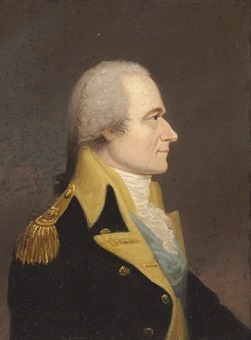
did hamilton wear a wig or powder his hair? at the very least it doesn’t look like he’s wearing one in the ezra ames portrait, but that would’ve been when wigs had pretty much gone out of style. i mean, after studying a bunch of portraits i’m under the impression that it’s his natural (fairly curly) hair, but i really don’t know.
if someone powdered their hair, how often did they do so and how often did they remove the powder? i know it was messy and greasy, it seems difficult to sleep in.
if a man wore a wig, did he always shave his real hair?
did men sleep with their hair in a queue? did they use some kind of hair net to keep their pillows clean?
honestly, if you know the answer to any of these questions (or if you just have some thoughts to add) hmu. i swear there’s a reason i’m asking, though it’s not a very good reason.
Hamilton powdered his hair. His son James remembered that his father had basically a daily hairdresser who powdered, pomatumed, combed, platted, and clubbed his hair back in a queue. That kind of hair styling had the potential to take a couple of hours. It was generally believed at this time that the hair powder is what kept the hair clean.
I can’t find info on how often they removed the powder, but to keep their pillows clean when their hair was powdered, they wore night caps,
*cracks knuckles* Finally, my time has come! *uses interest in 18th Century fashion and grooming for good and not for evil*
A typical hair care and styling regimen for women, and fashionable men who did not wear wigs, in the 18th century was:
1. Take down your hairdo at the end of the day, massage a small amount of pomatum, a mixture of mutton fat, lard, and aromatic oils such as clove and lemon, into the hair and scalp, add powder, and brush vigorously for quite some time. The effect is similar to contemporary dry shampoos. Although very rarely, if ever, washed with water and soap, this routine effectively cleans the hair and scalp without stripping natural oils and leaving it full of texture and body and enough oils to make styling easier– squeaky clean, freshly shampooed hair is notoriously hard to style, especially in elaborate updos and curls. Men and women alike wore nightcaps to protect their bedding from any powder or pomatum that might be left and probably also to help prevent long hair from getting too messed up. Unlike women, men might not undo their hair every night, and would wear hairnets to help preserve their style overnight.
2. In the morning, more powder was added before brushing. Powder was made of finely ground starch, bones, and clay, along with aromatic powders such as orris root. Women who wished to achieve towering ‘dos rolled sections of their hair over fluffy pads and added curls with curling irons. Men usually did not have the towering hairdos, but definitely would have added curls with a curling iron, if they had the luxury of a hairdresser (I read that Hamilton had a hairdresser come to his house every day, so he may have added curls sometimes). If a lighter white color was desired, the hairdresser would apply more powder to the finished style with a large puff while their client covered their face with a cone-shaped piece of paper so it didn’t also get powdered.
3. Wigs. Contrary to popular belief, women achieved many of their towering hairstyles without wigs. Most women wore their own, natural hair with, perhaps, extensions to bulk it out a bit if necessary. However, most of the popular, everyday styles could be achieved simply with waist-length hair, pads, and curls. Men, on the other hand, routinely wore wigs. Covering baldness was a big part of wigs’ popularity among men, but also, the time involved in styling hair may have interfered with men who had business, politics, and other important matters to attend to. Wigs could be sent off to a professional for regular maintenance and simply plopped on the head in the morning, like a hat. Men who wore wigs usually kept their natural hair cut very short, or even shaved, as in this picture from Hogarth’s “A Rake’s Progress”, where the main character has let his wig fall to the floor:
And this handsome gentleman, lounging at home in informal leisure wear– a banyan and nightcap:
Because wigs were expensive, they marked social class, with the most elaborate styles that required the most upkeep for the wealthy and the fops, and simpler styles that varied according to occupation and income.
By the late 1700s, however, wigs were already on their way out. Men of all social classes preferred styles that were fairly simple, and by the 1780s, natural, lightly powdered hair was preferred. In most of the portraits of the Founding Fathers and others who fought in the American Revolution, for example, you see that they are wearing their natural hair, not wigs.
Hamilton, ca. 1780– this is his own hair (I’m assuming, because the hairline is consistent with other portraits and he was probably too poor to even own a wig at this point), but it has been styled to look very much like the popular wig styles of the 1770s-early 80s: brushed back from the forehead, rolled over a pad or simply bulked up with enough pomatum and powder to make a nice roll near the ears, and tied in either a queue or bag in the back:
Which is, incidentally, how George Washington wore his hair, and since Hamilton was his Aide de Camp at the time this portrait was painted, it’s not surprising he wears the same style as his commander.
By 1800, he was wearing his hair like this:
It looks to me like the sides have been curled or rolled vertically to frame his face, while the back is combed flat and tied in a low queue.
This is another view of the same general style. You see the lightly powdered hair brushed up and fluffed a bit with the help of pomatum and powder for volume and hold over his head and around his face. You can see that by the late 1700s-early 1800s, men’s hair was fairly natural-looking, and required a minimal amount of styling and maintenance.
In England, in the 1790s only older men and women being presented at court wore wigs, and in 1795, the British government levied a tax on hair powder that basically ended powdered hair and fashions that relied upon it. However, powdered hair was already mostly over in the US, France and with political progressives in England because of the revolutions: elaborate, powdered hairstyles were associated with aristocracy.
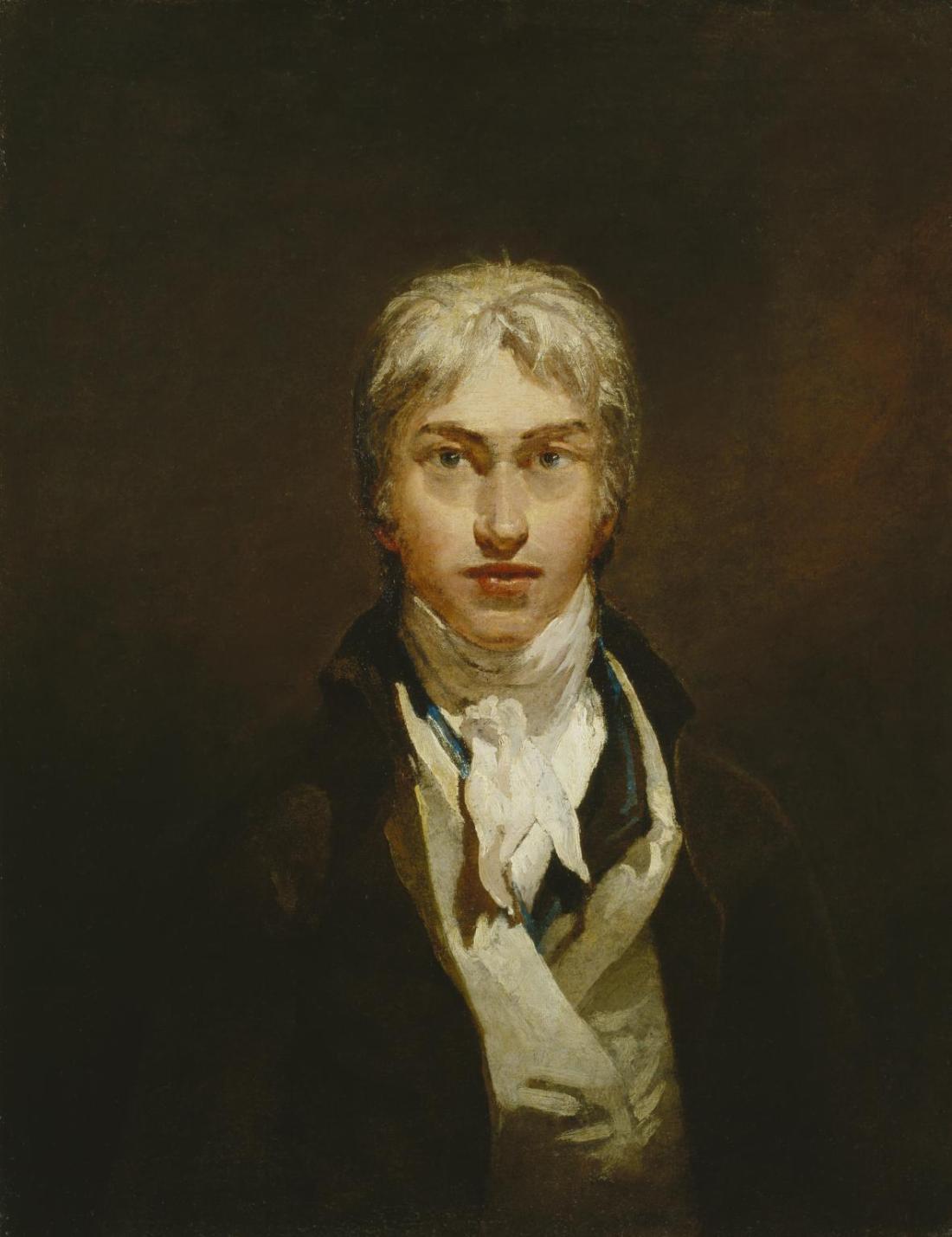
“Self-portrait”, ca. 1799, Joseph Mallord William Turner, Tate Britain.
By 1799, Turner was already an accomplished painter and had made a name of himself, also about this time he was elected as an Associate of the Royal Academy. So, let’s enjoy his particular style of landscape-like strokes in this self-portrait from when he was about 24 years old.
Also: don’t you love the feeling of watercolour this painting has even though it is oil on canvas? Good Lord, I really love Turner.
Everything I know? Oh dear. I’d have to write a book, I’m afraid. Instead, I’ll give you 10 tips on fun ways to celebrate his birthday.
No food is not an option. Lafayette was never one to shy away from a meal. Many of his funniest anecdotes revolve around food (the time he begged the American officers not to eat him for dinner, the time he showed up at what was to be his American HQ and started eating and his host thought him incredibly rude to start without the Marquis…who she was convinced was not him because he was too young). If you’re feeling especially accurate, include ham in your meal planning. Washington gifted Lafayette some of his Virginian ham after the Frenchman had returned to his native country and Laf was always excited to receive it. If ham’s not an option, any American food will do. The Lafayette family often served American dishes to their guests…to the disappointment of those hoping to experience a little French cuisine.
Feel free to get turnt up. Drinking was a normal aspect of 18th century dining, but Laf was no stranger to excess. He drank ale when other options weren’t available, but most of the time he seems to have preferred wine (especially Madeira while in America because it was available and Washington’s favorite…but it’s incredibly hard to track down). He and his entourage drank Jefferson’s wine cellar practically dry during his 1824-1825 tour of the U.S. Laf also believed copious amounts of wine was good for his health–or, that was his excuse anyway. If you’re of legal drinking age…go for it.
Dance! Laf, as we all know, had two left feet according to his acquaintances in France. But in the U.S., no one seems to have noticed! As far as I’ve read, Lafayette wasn’t bad at all in the minds of the Americans who hosted the dinners, balls, and parties he attended. In fact, a number of ladies were actually quite pleased with his performance and manners at these events. Which brings me to my next suggestion.
Flirting is allowed and encouraged. Hey…you’re the one who wanted to know authentic ways to channel your inner Lafayette on his birthday. If you want to get into the spirit of things and happen to be at an acceptable social gathering, a little charm here and there with those who’ve piqued your interest will fit right into the theme. Just be respectful and remember: consent is the only acceptable course of action.
Overdo your enthusiasm for America. Take a moment to be excited that America exists and be incredibly proud of her achievements. Even if you’re not American. Perhaps especially if you’re not American. Definitely pay some serious homage to George Washington. You should probably drink to the United States and give a brief speech about how much America’s success means to you. Go on. It’s essential! Do it for the aesthetic.
Take a moment to appreciate your significant other. Chances are, if someone’s agreed to be a long-term part of your life, they’re pretty special. Adrienne de Lafayette was one of the most loyal women who has ever graced the planet with her presence…and Laf found out the hard way that life without her was a tragedy. Give your loved one an extra kiss for being awesome enough to stick by you through thick and thin.
Stay away from boats. While Hamilton fans love depicting Lafayette heroically sailing in on a war frigate brandishing a sword like a champ, the more accurate depiction would be a very green Frenchman puking over the side. Stay on land while you celebrate.
Be friendly to everyone you meet. It’s just for one day–it won’t kill you, I promise. A little charm here and there is good for the soul…and this is Lafayette we’re talking about! This is a guy who, as a Frenchman and an American general, was excited to see an acquaintance of his from London on the British side during a prisoner exchange. If you want to get into the spirit, challenge yourself to see an opportunity for bridge-building in every introduction you encounter. Have fun.
Roleplay suggestions. Favor your left leg. Find the nearest horse and become friends with it. Text a bunch of your friends and when they don’t respond in five minutes, send them three more texts about how you value their friendship and how much silence irritates you. Locate a paternal-looking older man and adopt his as your surrogate father against his will. Find a confined, cold, dark, damp space and dream about how everything will get better once you’re welcomed to America by all the people you helped. The possibilities are endless……..
You’re gonna need 260 candles. That’s right! Two centuries and six decades of adorkable French enthusiasm gracing our history with his legacy. Vive Lafayette!












 Daintyfire