It’s Alexander Hamilton’s birthday today, so I thought I would look into the ways in which Americans celebrated birthdays in the late 18th-century. I found very, very little. So, I dug through everyone’s favorite website, Founders Online, and found any mention of birthdays I could. Royal birthdays were traditionally marked by large balls and other public celebrations, and after the colonies declared independence they began to celebrate George Washington’s birthday this way instead. Since Washington’s birthdays were outliers, I ignored them.
In general, it seems that personal birthdays were widely celebrated. Benjamin Franklin’s wife, Deborah, wrote him in 1765 to say that their friend Mr. Bartram (presumably John Bartram) “asked us to celebrate his Birthday.” Celebrating a birthday in someone’s absence seems to have been relatively common: Eleanor Morris, Mary Hewson, and Sarah Bache all wrote Franklin to let him know that they would be keeping his birthday, in 1768, 1779, and 1783 respectively. Morris says that she and her cousins celebrated his birthday (“that Happy Day”) by having plum pudding with their dinner and drinking tea to his health. Bache, his daughter, claims to keep Franklin’s birthday “in the most festive Manner in my power,” and invited sixty children over for a dance.
Birthdays for children were certainly celebrated. Franklin’s illegitimate grandson, William Temple Franklin, wrote to his cousin to say that he would be visiting a friend to celebrate their son’s first birthday. In 1771, Benjamin Franklin wrote to Deborah to say that he celebrated his grandson’s birthday with friends: “At Dinner, among other nice Things, we had a Floating Island, which they always particularly have on the Birth Days of any of their own Six Children.” A floating island is a French dessert, basically meringue floating on crème anglaise. Apparently, fancy desserts were considered an acceptable way to celebrate a birthday.
I found two instances of personalized poems written in honor of someone’s birthday. In 1767, Benjamin Franklin wrote a poem for Mary Stevenson, the daughter of his London landlady, which included the line “You’d have the Custom broke, you say, That marks with festive Mirth your natal Day,” which also implies that birthday parties were considered customary. On February 21st, 1793, George and Martha Washington sent a birthday greeting to Elizabeth Willing Powel and expressed their regrets that they were unable to attend her 50th birthday party that evening. They also enclosed a personalized birthday poem. In 1814, John Quincy Adams’s seven-year-old son wrote from Saint Petersburg to say that he had performed in a French play at the birthday dinner of a Mr. Krehmer (presumably Sebastian Krehmer, a banker). The dinner ended with a dance.
John Adams, in true New England fashion, marked his 37th birthday by writing this in his journal: “Thirty Seven Years, more than half the Life of Man, are run out.—What an Atom, an Animalcule I am!—The Remainder of my Days I shall rather decline, in Sense, Spirit, and Activity. My Season for acquiring Knowledge is past.” Slightly more optimistically, he writes, “And Yet I have my own and my Childrens Fortunes to make. My boyish Habits, and Airs are not yet worn off.” Two years later, he noted his 39th birthday but wrote nothing else about it and seemed to have spent most of the day traveling.
If we sometimes caricature Ben Franklin as our most bacchanalian founder, and John Adams as a bit of a Puritan stick-in-the-mud, I feel like these examples provide a good range. There are many other examples of letters that simply begin with a birthday greeting, or dates that note that it’s the author’s birthday. Most people seem to have kept track of their birthdays and mentioned them to friends and family, and quite a few seem to have celebrated with dinners, poems, special desserts, and even dances.
So, what about our birthday boy, Alexander Hamilton? Well, he never mentions his birthday in any of his surviving letters. On January 10th, 1772, the day before his 17th or 15th birthday, he wrote to his employer, Nicholas Cruger, to let him know how business was going. At the end, he thanked Cruger “for the Apples you were so kind as to send me,” but there is no other personal information. It seems extremely unlikely that these apples were some sort of birthday gift, since the last letter he’d had from Cruger was from December 20th, 1771. The only notable thing about Hamilton’s birthday seems to be that he didn’t take a break. There are plenty of work-related letters sent on the 10th, 11th, and 12th of January throughout his life. On his 34th or 36th birthday, he wrote a particularly lengthy one to Thomas Jefferson, entirely concerned with politics. So if you were curious about how Hamilton celebrated his birthday…he might not have.
Happy 259th/261st birthday, Hammy!
Tag: john adams
When Lafayette visited John adams later in his life, they both commented on how both had changed dramatically since they had last met. Something like “That was not the mani knew”, I’m paraphrasing mind you, but what could have been the change? Were there significant changes in Lafayette’s views at this time?
After the war, during the initial trade negotiations with the newly established United States, Lafayette often strove to interject his own opinions on the matter and wrote to Vergennes and others about what might be beneficial for both countries. Because John Adams needed to be seen as a legitimate ambassador from the United States at the time, Lafayette’s interceding wasn’t welcomed by the future president…and honestly, he wasn’t wrong about that. It’s completely understandable. Lafayette had a tendency to overdue everything put in front of him. At one point, Adams–fed up with the interference–wrote this about the Marquis, convinced that Laf only acted in order to beef up his own sense of personal glory:
‘…this Mongrel Character of French Patriot and American Patriot cannot exist long.’
Over time, John Adams began to suspect Lafayette’s character on the whole, convinced that the Frenchman’s constant involvement was a sign of future problems to come. Their relationship continued on a downward spiral after the establishment of the Society of the Cincinnati, a hereditary society for those who fought in the American Revolution. Adams, who was adamantly opposed to the idea, did not approve of Lafayette’s enthusiastic participation in the Society. John gradually grew to dislike the Marquis on the whole–and he began making it clear.
‘as to your going to America, Surely I have no Objection against it…but I questioned whether you would go, as the War was over, and I knew of no particular Motive you might have to go.’ – March 28, 1784
Lafayette, who had no intention of being an enemy of American progress, didn’t understand the low-key hostility he was receiving.
‘A friendly letter I wrote You, and the One I Receive is not so affectionate as usual….As to My Going to America, I first Went for the Revolution….Now I am Going for the people, and My Motives are, that I love them, and they love me–that My Arrival will please them, and that I will Be Pleased with the sight of those whom I Have Early joined in our Noble and successfull cause….How could I Refrain from Visiting a Nation whose I am an Adoptive Son…?’
Judging by the incorrect English phraseology, the adamant tone, and the copious overuse of capital letters, Lafayette was upset. Adams didn’t reply.
‘Altho’ I have not Been Honoured with an answer to My last letter, I will not loose time in Acquainting you that My departure from l’Orient is fixed on the 22d instant.’
Lafayette offered to deliver any correspondence that John might have. Adams, once again, pulled a Mean Girls.
‘…as there was nothing in it [Lafayette’s prior letter] which required an immediate Answer, I have not acknowledged the Recipt of it, untill now. I will answer the Letters of my Friends by Mr. Reed and Coll. Herman.’
Reed and Herman were mentioned pointedly; they were Americans…and Lafayette was not. Lafayette wrote one more time and, as Laura Auricchio (author of The Marquis: Lafayette Reconsidered) put it, ‘As far as we know, it went unanswered.’ So, when Adams and Lafayette met during Lafayette’s tour of America later in his life, this was the last real correspondence that had gone on between them. Adams, who was in his late 80′s, must’ve looked withered to Lafayette, who was in his 60′s and had known a much more fiery Adams than the elderly man he met.
“John Adams showed how truly thickheaded he could be when he wrote from Paris to his wife running his business and raising his children back in Braintree, Massachusetts. ‘I admire the ladies here,’ he oh so sensitively said, ‘Don’t be jealous. They are handsome and very well educated. Their accomplishments are exceedingly brilliant.’ Abigail had a ready reply: ‘I regret the trifling narrow contracted education of females in my own country…. You need not be told how much female education is neglected, nor how fashionable it has been to ridicule female learning.’ I suspect he needed not be told because she had told him again and again.”
—
the death of john adams june 30 1778
(Founding Mothers by Cokie Roberts)
“John and Abigail continued to worry over their son’s [Charles’s] alcoholism, and they were outraged when he squandered some of John Quincy’s money that had been entrusted to his care. But something else concerned them as well, although their correspondence and that of Charles’s siblings contains only dark hints and allusions with regard to this other, unspecified behavior. There are references to his alleged proclivity for consorting with men whom his parents regarded as unsavory. John Quincy, who remained a close, tolerant older brother through thick and thin, urged Charles to “be more cautious” and prayed that his conduct would remain within “the limits of regularity.” By the early 1790s, such references may have been occasioned by the fact that Charles was living in New York with an old revolutionary war general, Baron Friedrich von Steuben, who is now thought by some to have been homosexual. Charles clearly adored Steuben – “My dear Mamma there is something in this man that is more than mortal,” he told Abigail – and he was grief stricken when the old man retired to a farm in upstate New York. Following Steuben’s departure, Charles announced his intention of marrying Sally Smith, the sister of his brother-in-law Colonel Smith. Whereas his parents often interceded in John Quincy’s and Thomas’s matrimonial concerns, the vice-president and Abigail seemed almost relived at their son’s decision. Even Nabby breathed a sigh of relief. After “all the Hair breadth scares and iminent dangers he has run, he is at last Safe Landed,” he exalted.”
— John Ferling, John Adams: A Life (via publius-esquire)
Charles also had a long history of extreme emotional fragility and a strange and persistent childishness. He was very wont to court multiple girls at once, none seriously, and, as his money issues show, tended to befriend people who then manipulated and preyed upon him.






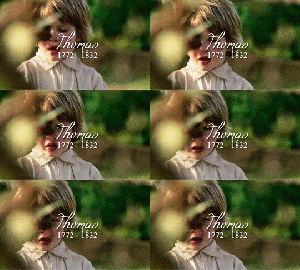

The Unfortunate Adams Children
Each of the four surviving children of John and Abigail Adams suffered a great deal of hardship and personal tragedy during their lives. In childhood, they were all frequently separated from their father–and eventually from their mother as well–due to his involvement in the American Revolution. But their struggles had only begun.
The firstborn–Abigail, called “Nabby”–married a financial failure who had difficulty supporting her and their four children. In 1810, she was diagnosed with breast cancer and underwent a painful mastectomy, but after two years of remission, she eventually returned to her parents’ home in Massachusetts and died in her father’s arms. John Quincy, the eldest Adams son, had a successful career in diplomacy and politics that mirrored his father’s and culminated in his election as the sixth President of the United States. However, he suffered a bitter political defeat after losing his reelection campaign to Andrew Jackson. He may also have struggled with depression, and two of his own three sons were troubled and died in young adulthood. (He and his wife Louisa lost a daughter in infancy as well.) Charles was a charming child and a favorite of both his parents. Like his brothers, he attended Harvard, married, and began a promising legal career in New York–but behind closed doors, he struggled with a severe alcohol problem. His habits were so disgraceful that his father disowned him, calling him a “Beast,” before he died of cirrhosis of the liver at just thirty years old. The youngest Adams child, Thomas, also began his adult life with promise. He and his wife had seven children, but unfortunately he shared Charles’ alcoholism (the disease ran in Abigail’s family). His decline was much slower, but he was frequently ill and had amassed large debts by the time he died in 1832.
John and Abigail also had a fifth living child, Susanna, but she was sickly and lived for only fourteen months. Abigail’s last pregnancy ended in the stillbirth of what would have been her third daughter. They called the baby Elizabeth.
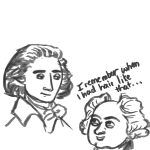
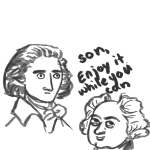
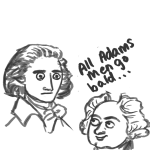
John Adams On Sex
Here it may be proper to recollect something which makes an Article of great importance in the Life of every Man. I was of an amorous disposition and very early from ten or eleven Years of Age, was very fond of the Society of females. I had my favorites among the young Women and spent many of my Evenings in their Company and this disposition although controlled for seven Years after my Entrance into College returned and engaged me too much till I was married.
I shall draw no Characters nor give any enumeration of my youthfull flames. It would be considered as no compliment to the dead or the living: This I will say—they were all modest and virtuous Girls and always maintained this Character through Life. No Virgin or Matron ever had cause to blush at the sight of me, or to regret her Acquaintance with me. No Father, Brother, Son or Friend ever had cause of Grief or Resentment for any Intercourse between me and any Daughter, Sister, Mother, or any other Relation of the female Sex. My Children may be assured that no illegitimate Brother or Sister exists or ever existed. These Reflections, to me consolatory beyond all expression, I am able to make with truth and sincerity and I presume I am indebted for this blessing to my Education.
My Parents held every Species of Libertinage in such Contempt and horror, and held up constantly to view such pictures of disgrace, of baseness and of Ruin, that my natural temperament was always overawed by my Principles and Sense of decorum. This Blessing has been rendered the more prescious to me, as I have seen enough of the Effects of a different practice. Corroding Reflections through Life are the never failing consequence of illicit amours, in old as well as in new Countries. The Happiness of Life depends more upon Innocence in this respect, than upon all the Philosophy of Epicurus, or of Zeno without it. I could write Romances, or Histories as wonderfull as Romances of what I have known or heard in France, Holland and England, and all would serve to confirm what I learned in my Youth in America, that Happiness is lost forever if Innocence is lost, at least untill a Repentance is undergone so severe as to be an overballance to all the gratifications of Licentiousness. Repentance itself cannot restore the Happiness of Innocence, at least in this Life.
John Adams takes time out of his autobiography to lecture on the dangers of ‘libertinage’.
The collected part of the semen, raised and enflamed became a Lust converted to choler turned head upon the spinal duct, and ascended to the brain. The very same principle that influences a bully to break the windows of a whore that has jilted him, naturally stirrs up a great Prince to raise mighty armies, and dream of nothing but sieges, battles and victories. In this place I cannot avoid introducing a reflection by way of transgression. What a pity it is that our Congress had not known this discovery, and that Alexander Hamilton’s projects of raising fifty thousand Men, ten thousand of them to be Calvary and his projects of sedition Laws and Alien Laws and of new taxes to support his army all arose from a superabundance of secretions which he could not find whores enough to draw off! and that the same vapours produced his Lyes and Slanders by which he totally destroyed his party forever and finally lost his Life in the field of Honor.
John Adams to Doctor Benjamin Rush, Nov. 11 1806, in which he chalks up Hamilton’s problems to simply not getting laid enough. (via publius-reporter)
Adams what is your problem.
(via foundingfatherfest)
Oh John Adams. You amuse me so. (Everyone needed to get laid more. Did none of you learn from Franklin’s example?)
John Adams: called Hamilton “the bastard brat of a Scotch pedlar”
John Adams: called Hamilton a “Creole bastard”
John Adams: decried the adversities Hamilton faced as personal failures
John Adams: called Hamilton an “aspiring mortal” (???)
John Adams: accused Hamilton of incest
John Adams: called Hamilton a slacker (!?!?!?)
John Adams: spread a rumor that Hamilton “never wrote or spoke… in public without a bit of opium in his mouth.”
Also John Adams: “I never wrote a line of slander against my bitterest enemy.”
😑😑😑
I was much amused, among some People here who understand a little English, to hear them puzzling each other with Samples of English Sentences, very difficult to be pronounced by a Frenchman. Among many others I remarked the following and very curious indeed were the Attempts to pronounce them. “What think the chosen judges?” “I thrust this Thistle through this Thumb.” “With an Apple in each hand and a third in my Mouth.” But of all the Words I ever heard essayed by a French Man, the Words “General Washington” produced the greatest Variety of difficulties. I know not that I ever heard two Persons pronounce them alike, except the Marquis de La Fayette and his Lady. They had studied and practised them so long that they had mastered the great Subject. In my second Voyage to France, I carried with me a Friend as a private Secretary,Mr. John Thaxter. His name was a new Problem of Pronunciation. I could have filled a Sheet of Paper with the Varieties of Sounds, which these two Names suggested to my French Friends. “VAUGSTAINGSTOUNG” was one of the Sounds for Washington: and “TAUGISTEY,” was another for Thaxter.
John Adams, autobiography, part 2, “Travels, and Negotiations,” 1777-1778 sheet 37 of 37, 18 – 25 July 1778
XD
(via madtomedgar)
I love that Lafayette spent a lot of time practicing Washington’s name. XD
(via publius-esquire)
 Daintyfire