You teach your kids to fear everything. And when they get older, they are too afraid to get a house of their own because they don’t know how to be an adult. They become afraid of making the wrong decisions. You can’t expect your children to act like adults when you’ve protected them their whole life and didn’t teach them what they need to know. You’re either going to raise someone to be insecure and fearful, or you’re going to raise a rebel that walks all over you. Kids need balance. Kids need to be given the opportunity to make mistakes they can learn from. And they deserve a parent that will guide them through it, not for you to put a blindfold over their eyes. I get that you’re trying to help them; You’re not. You have taught your children to rely on you. You didn’t let them make mistakes. Now they don’t even take opportunities if they are uncertain of the outcome.
Tag: kids
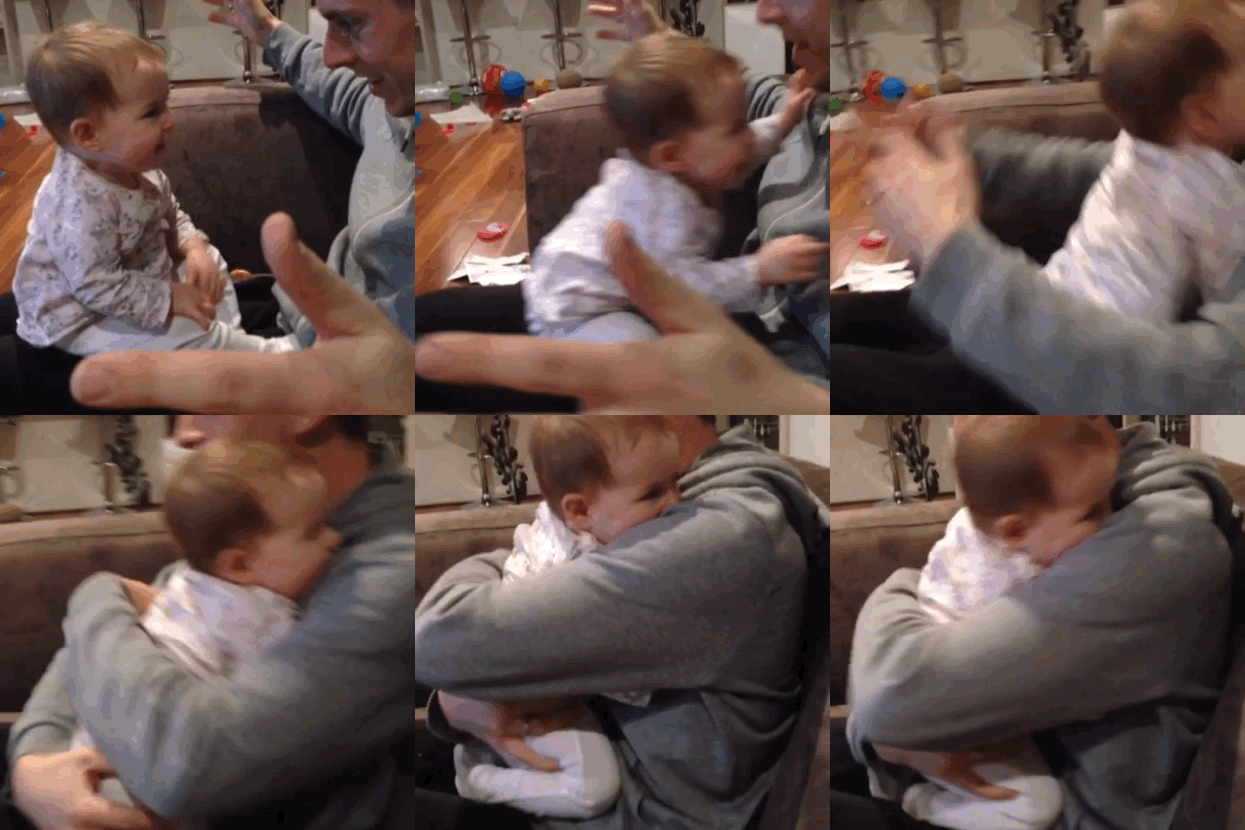

Children are not property, they are human beings. They belong to themselves and you are supposed to love and protect them.
child handling for the childless nurse
My current job has me working with children, which is kind of a weird shock after years in environments where a “young” patient is 40 years old. Here’s my impressions so far:
Birth – 1 year: Essentially a small cute animal. Handle accordingly; gently and affectionately, but relying heavily on the caregivers and with no real expectation of cooperation.
Age 1 – 2: Hates you. Hates you so much. You can smile, you can coo, you can attempt to soothe; they hate you anyway, because you’re a stranger and you’re scary and you’re touching them. There’s no winning this so just get it over with as quickly and non-traumatically as possible.
Age 3 – 5: Nervous around medical things, but possible to soothe. Easily upset, but also easily distracted from the thing that upset them. Smartphone cartoons and “who wants a sticker?!!?!?” are key management techniques.
Age 6 – 10: Really cool, actually. I did not realize kids were this cool. Around this age they tend to be fairly outgoing, and super curious and eager to learn. Absolutely do not babytalk; instead, flatter them with how grown-up they are, teach them some Fun Gross Medical Facts, and introduce potentially frightening experiences with “hey, you want to see something really cool?”
Age 11 – 14: Extremely variable. Can be very childish or very mature, or rapidly switch from one mode to the other. At this point you can almost treat them as an adult, just… a really sensitive and unpredictable adult. Do not, under any circumstances, offer stickers. (But they might grab one out of the bin anyway.)
Age 15 – 18: Basically an adult with severely limited life experience. Treat as an adult who needs a little extra education with their care. Keep parents out of the room as much as possible, unless the kid wants them there. At this point you can go ahead and offer stickers again, because they’ll probably think it’s funny. And they’ll want one. Deep down, everyone wants a sticker.
this is my dream
this is how i want to die
THEY’RE EATING HIM
God, I Wish That Was Me.
(Source: https://www.instagram.com/)
When your child says “Why can’t I get a puppy?”
Instead of defaulting to “My house, my rules”
Try “Any pet is a lot of responsibility. A puppy would have to be fed, walked, and taken outside to use the bathroom several times a day and taken for regular check-ups and vaccinations at the vet. You can’t do all of that by yourself, and I/we don’t have the time or money either.”
When your teenager says “Why can’t I come home at 2:00 this Saturday?”
Instead of defaulting to “My house, my rules!”
Try “The time you come home is a matter of respect and consideration. I/We will not only be concerned for your safety, but we would either be disturbed in the middle of the night when you arrive or forced to stay up for several extra hours waiting.”
When your child says “Why am I not allowed to do this thing?”
Instead of defaulting to “My house, my rules!”
Try actually communicating a legitimate reason, because children pick up on subtlety and on context and on the unspoken messages, and it’s better to teach children lessons like “You should think really hard before taking on new responsibilities” and “It’s important to show consideration for the needs of the people with whom you share a living space” than lessons like “It’s okay for people to demand your absolute obedience so long as you’re dependent on them for survival.”
TRUTH
Also worth knowing: training your child to accept arbitrary ‘reasons’ for obedience like ‘because I said so’ and ‘my house my rules’ etc trains them to be more susceptible to peer pressure because in their mind, when someone who is at all an authority (older than them, bigger than them, more impressive than them, more confident than them) demands something, they should accept it and not think about it critically.
Let them ask why, and give them a real reason. If not, don’t be surprised when they fall for lots of bullshit when they are older. You’re the one that made them believe ‘BECAUSE’ was reason enough.
Also, for children who are too stubborn or questioning to accept arbitrary answers like “because I said so,” your reply basically reads as “I don’t have a real reason.”
This is also dangerous because then they’ll assume this is true for all the other warnings you give, even important ones that are meant to keep them safe or protect them from abuse. They won’t think, “Oh, this is a bad idea because x y z,” they’ll think “My parent said not to do this but I bet there’s no real reason why, so I might as well do it anyway.”
I never obeyed my parents as a kid because they never took the time to give me legitimate reasons why I shouldn’t do things. It didn’t always turn out well for me. Talk honestly to your kids.
The slow surrender of his hand is everything.
This video gave me life
Here are fifteen of my favourite seconds from the internet.
Dath Vader’s a teddy bear
 Daintyfire